
Claude Opus 4.6: A Deep Dive Into Anthropic's Most Powerful Model and How It Stacks Up Against GPT-5, Gemini 3, Llama 4, and DeepSeek R1
Claude Opus 4.6: A Deep Dive Into Anthropic's Most Powerful Model and How It Stacks Up Against GPT-5, Gemini 3, Llama 4, and DeepSeek R1
Introduction: Twenty Minutes That Shook the Industry
On February 5, 2026, Anthropic released Claude Opus 4.6. Twenty minutes later, OpenAI fired back with GPT-5.3 Codex. Within two days, a trillion-dollar selloff swept enterprise software stocks on the Nasdaq, its worst two-day tumble since April. Thomson Reuters fell 15.83%. LegalZoom dropped nearly 20%. Financial data providers like FactSet, S&P Global, and Moody's saw sharp declines.
The message from markets was blunt: when an AI model scores 90.2% on BigLaw Bench, 76.0% on TaxEval, and can orchestrate teams of agents that build 100,000-line C compilers from scratch, the incumbents in knowledge work have a problem.
But the hype cycle around every model release makes it hard to separate signal from noise. Does Opus 4.6 actually deliver? Where does it stumble? And how does it compare to the increasingly crowded field of frontier models from OpenAI, Google, Meta, and DeepSeek?
This article breaks it all down: the architecture, the benchmarks, the pricing, the real-world performance, and the caveats you need to know before betting your stack on any single model.
What Is Claude Opus 4.6?
Claude Opus 4.6 is Anthropic's flagship model, released February 5, 2026, as the direct successor to Opus 4.5 (November 2025). It is Anthropic's first major model launch of 2026 and carries the simplified API identifier claude-opus-4-6 (no date suffix).
At a high level, Opus 4.6 is designed to be the best model available for three use cases: agentic coding, enterprise knowledge work, and long-context reasoning. Anthropic describes it as the model that "plans more carefully, sustains agentic tasks longer, operates reliably in larger codebases, and handles complex, multi-step workflows with greater autonomy."
It is available on the Anthropic API, claude.ai, AWS Bedrock, Google Vertex AI, Microsoft Foundry, and GitHub Copilot.
What's New: The Six Headline Features
1. One Million Token Context Window (Beta)
The most immediately useful upgrade. Previous Opus models were capped at 200K tokens. Opus 4.6 expands to 1 million tokens in beta, available to API users at tier 4 and above.
To put this in perspective: 1M tokens is roughly 750,000 words, or about 10-12 full-length novels. You can ingest entire codebases, multi-year financial filings, or comprehensive legal document sets in a single context window.
Previous attempts at large context windows (including Anthropic's own Sonnet models) suffered from "context rot," where retrieval accuracy degraded as context approached capacity. Opus 4.6 addresses this through what Anthropic describes as "a structural expansion and a re-engineering of attention mechanisms." The results on the MRCR v2 benchmark (1M tokens, 8-needle retrieval) speak for themselves: Opus 4.6 scores 76% while Gemini 3 Pro manages only 26.3%.
Premium pricing applies above 200K tokens: 37.50 per million output tokens.
2. 128K Output Tokens
Output capacity doubles from the previous 64K limit to 128K tokens. This enables longer thinking budgets, comprehensive multi-file code edits, exhaustive reports, and full document generation in a single response. For agentic workflows where the model needs to reason extensively before acting, the extra headroom is significant.
3. Adaptive Thinking
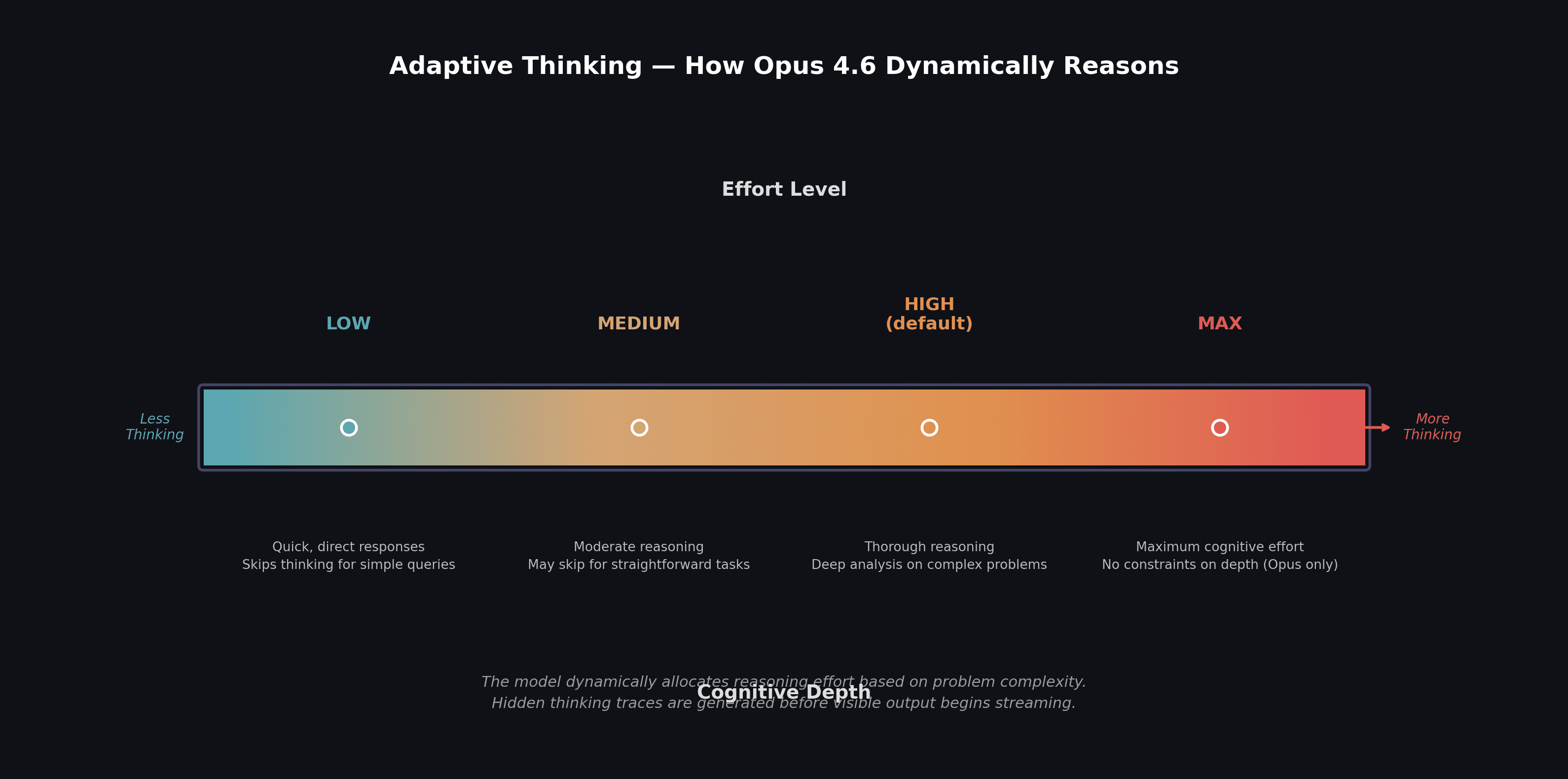
This is the architectural centerpiece. Opus 4.6 replaces the previous "extended thinking" system (where developers manually set a budget_tokens parameter) with adaptive thinking, a dynamic reasoning system where the model decides how hard to think based on problem complexity.
Four effort levels are available:
- Low: Quick, direct responses for simple queries
- Medium: Moderate reasoning for standard tasks
- High (default): Thorough reasoning for complex problems
- Max: Maximum cognitive effort for the hardest problems
The model generates hidden reasoning traces before streaming visible text. When set to adaptive mode, it automatically enables interleaved thinking, allowing reasoning between tool calls and between conversation turns rather than only at the beginning of a response.
One consequence: prefilling assistant messages is no longer supported on Opus 4.6. Requests with prefilled content return a 400 error, a breaking API change that requires migration for some workflows.
4. Agent Teams (Research Preview)
Perhaps the most forward-looking feature. Agent Teams enables multi-agent orchestration where multiple Claude Code agents work in parallel from a single orchestrator. Each sub-agent runs in its own tmux pane with an independent context window of up to 1M tokens.
Activated via the environment variable CLAUDE_CODE_EXPERIMENTAL_AGENT_TEAMS=1, this is currently a research preview. But the early results are striking: during testing, Agent Teams built a 100,000-line C compiler from scratch that boots Linux on three CPU architectures.
The architecture uses a distributed state model, eliminating the serial bottleneck of Opus 4.5 where sub-agents shared a single context window.
5. Context Compaction (Beta)
A server-side automatic summarization system. When conversations approach the context window limit, the API detects this and replaces earlier parts of the conversation with concise summaries, enabling effectively infinite conversations without manual context management.
6. Office Integrations
Claude in PowerPoint (research preview) reads existing layouts, fonts, and templates, then generates or edits slides while preserving design elements. Enhanced Claude in Excel can now interpret messy spreadsheets without explicit structure explanations. These are early signals of Anthropic moving beyond the API into direct enterprise workflow integration.
Benchmarks: The Complete Picture
Raw numbers matter, but context matters more. Here's how Opus 4.6 performs across every major benchmark, compared to its predecessor and the competition.
Core Benchmark Comparison
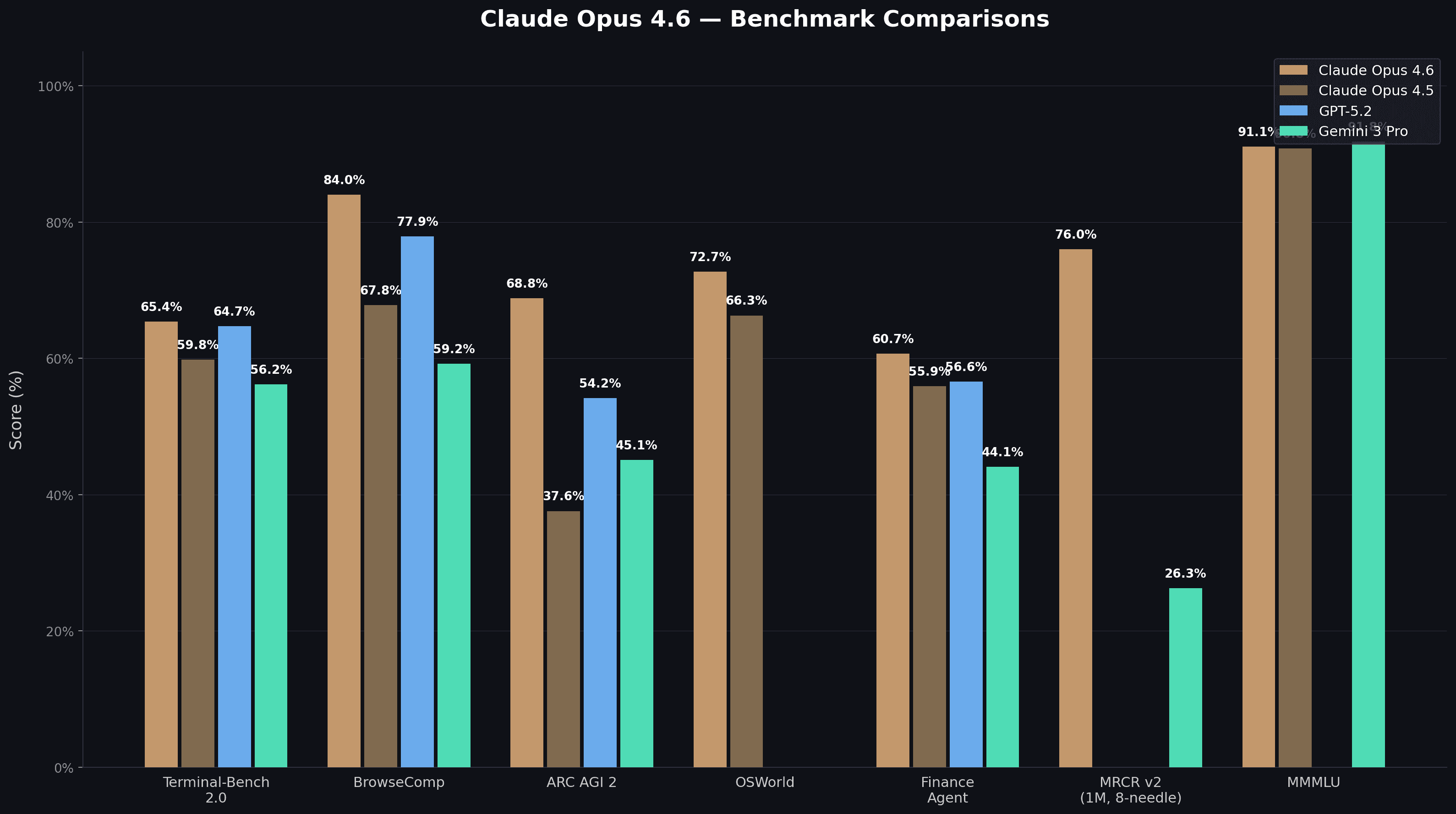
| Benchmark | Claude Opus 4.6 | Claude Opus 4.5 | GPT-5.2 | Gemini 3 Pro | Notes |
|---|---|---|---|---|---|
| Terminal-Bench 2.0 | 65.4% | 59.8% | 64.7% | 56.2% | Agentic terminal coding |
| SWE-bench Verified | 80.8% | 80.9% | -- | -- | Software engineering (marginal regression) |
| OSWorld | 72.7% | 66.3% | -- | -- | Agentic computer use |
| BrowseComp | 84.0% | 67.8% | 77.9% | 59.2% | Agentic web research |
| ARC AGI 2 | 68.8% | 37.6% | 54.2% | 45.1% | Novel problem solving |
| GDPval-AA Elo | 1,606 | ~1,416 | ~1,462 | -- | Enterprise knowledge work |
| Humanity's Last Exam | 53.1% (with tools) | -- | -- | -- | Multidisciplinary reasoning |
| Finance Agent | 60.7% | 55.9% | 56.6% | 44.1% | Financial analysis |
| BigLaw Bench | 90.2% | -- | -- | -- | Legal reasoning |
| TaxEval | 76.0% | -- | -- | -- | Tax analysis |
| MMMLU | 91.1% | 90.8% | -- | 91.8% | Multilingual understanding |
| MRCR v2 (1M, 8-needle) | 76% | N/A | -- | 26.3% | Long-context retrieval |
| MCP Atlas | 59.5% | 62.3% | 60.6% | -- | Tool use (regression) |
Intelligence Index Rankings
On the Artificial Analysis Intelligence Index v4.0, Opus 4.6 takes the top spot globally:
- Claude Opus 4.6 (Adaptive Reasoning): 53 points (#1)
- GPT-5.2: 51 points (#2)
- Claude Opus 4.6 (Non-reasoning): 46 points
Where Opus 4.6 Dominates
Novel reasoning (ARC AGI 2): 68.8%, nearly double its predecessor (37.6%) and 14.6 points ahead of GPT-5.2. This benchmark tests the ability to solve problems the model has never seen before, and it's arguably the most important signal for general intelligence progress.
Agentic web research (BrowseComp): 84.0%, crushing GPT-5.2 at 77.9% and Gemini 3 Pro at 59.2%. If you need an AI to autonomously gather and synthesize information from the web, Opus 4.6 is the clear leader.
Enterprise knowledge work (GDPval-AA): 1,606 Elo, beating GPT-5.2 by approximately 144 Elo points. In practical terms, Opus 4.6 wins about 70% of head-to-head matchups on knowledge work tasks.
Long-context retrieval: 76% on MRCR v2 at the full 1M-token context. For comparison, Sonnet 4.5 scored 18.5% on the same benchmark. The gap is enormous.
Where Opus 4.6 Regresses
SWE-bench Verified: 80.8% vs. 80.9% for Opus 4.5. A marginal regression, but worth noting since software engineering is a primary use case.
MCP Atlas (Tool Use): 59.5% vs. 62.3% for Opus 4.5. A 2.8-point drop in structured tool use accuracy. This regression may be related to the adaptive thinking architecture, where the model's dynamic reasoning approach occasionally interferes with precise tool calling patterns.
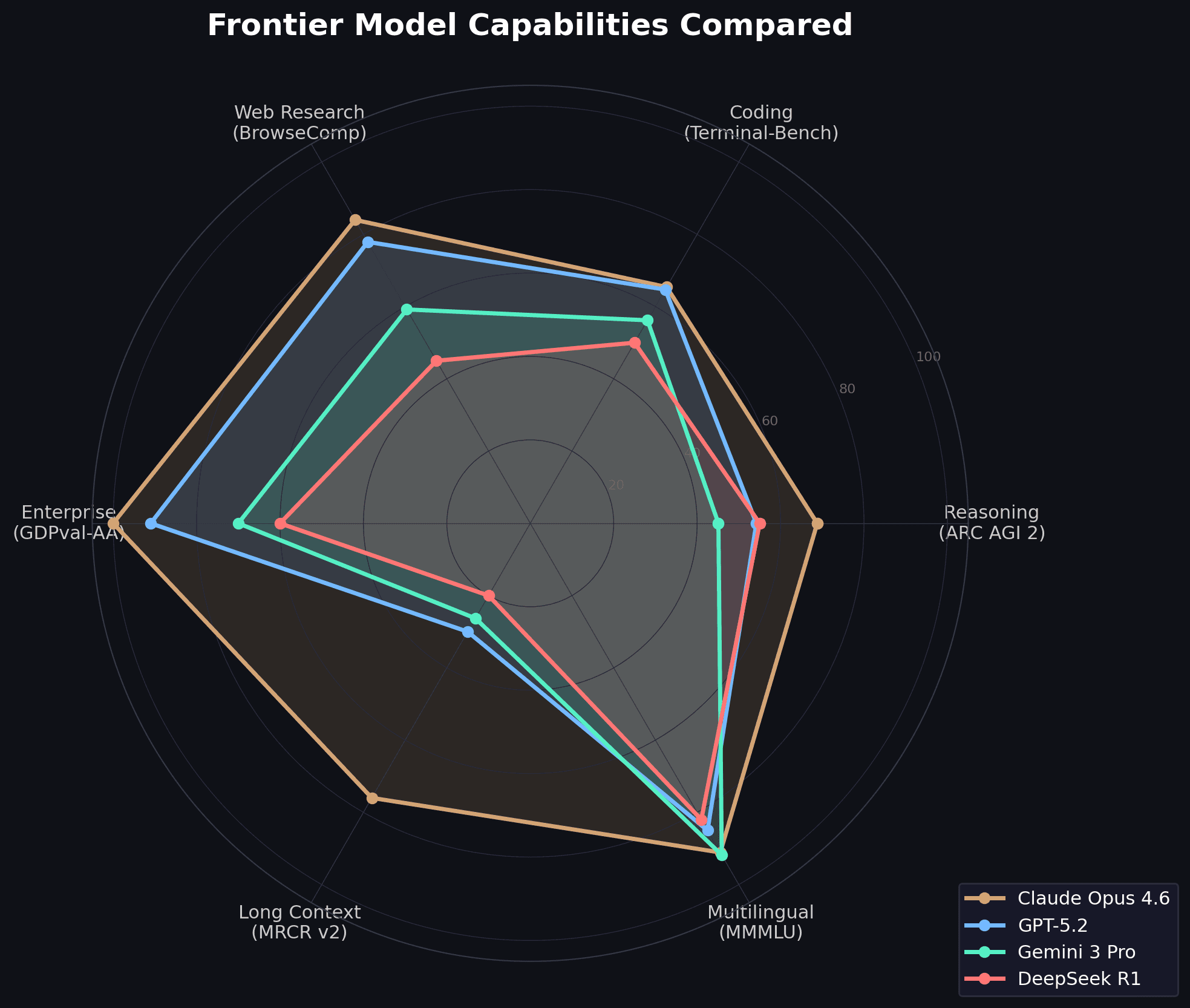
Head-to-Head: Opus 4.6 vs. The Competition
vs. OpenAI GPT-5.2
The most direct rivalry. Both models represent the frontier of commercial AI as of February 2026.
Opus 4.6 wins on:
- ARC AGI 2: 68.8% vs. 54.2% (+14.6 points)
- BrowseComp: 84.0% vs. 77.9% (+6.1 points)
- Terminal-Bench 2.0: 65.4% vs. 64.7% (+0.7 points)
- Finance Agent: 60.7% vs. 56.6% (+4.1 points)
- GDPval-AA: ~144 Elo points advantage
GPT-5.2 is competitive on:
- Terminal-Bench 2.0: only 0.7 points behind
- MCP Atlas: 60.6% vs. 59.5% (slightly better tool use)
Context window: Opus 4.6's 1M-token context is a significant advantage over GPT-5.2's offering.
In a 48-hour real-world review, developers reported Opus 4.6 delivering "consistent, reliable, production-ready code" while GPT-5.3 Codex "struggled with basic authentication and file handling." For writing tasks, both models are converging in quality, though GPT-5.3 Codex was noted to have "picked up some of Opus's warmth."
vs. Google Gemini 3 Pro
Gemini 3 Pro competes on breadth of modality, while Opus 4.6 competes on depth of reasoning.
Opus 4.6 wins on:
- Terminal-Bench 2.0: 65.4% vs. 56.2% (+9.2 points)
- BrowseComp: 84.0% vs. 59.2% (+24.8 points)
- ARC AGI 2: 68.8% vs. 45.1% (+23.7 points)
- Finance Agent: 60.7% vs. 44.1% (+16.6 points)
- MRCR v2 (1M context): 76% vs. 26.3% (+49.7 points)
Gemini 3 Pro wins on:
- MMMLU: 91.8% vs. 91.1% (+0.7 points)
- Native multimodality: text, images, audio, and video processing (Opus 4.6 does not process video)
- Real-time Google Search grounding
The long-context gap is the most dramatic finding. Despite Google's years of investment in long-context models, Opus 4.6 nearly triples Gemini 3 Pro's accuracy at the 1M-token mark. For any workflow that depends on processing large documents, Opus 4.6 has no peer.
vs. Meta Llama 4
The comparison between Opus 4.6 and Llama 4 is less about direct benchmark competition and more about fundamentally different philosophies.
Llama 4 Maverick (April 2025) uses a mixture-of-experts (MoE) architecture: 17B active parameters across 128 experts, approximately 400B total parameters. It's open-source, meaning organizations can self-host, fine-tune, and deploy without per-token costs.
| Dimension | Claude Opus 4.6 | Llama 4 Maverick |
|---|---|---|
| Access | Proprietary API | Open-source (self-hostable) |
| Context Window | 1M (beta) | 10M (Scout variant) |
| Coding (CodeEval) | ~85.6% (Claude 4 Core) | 86.2% |
| Multimodal Reasoning (MMMU) | 84.9% | 82.3% |
| Video Processing | No | Yes |
| Cost at Scale | Per-token API pricing | Infrastructure + compute only |
Llama 4 Scout's 10M-token context window is ten times larger than Opus 4.6's 1M, though raw window size means little without retrieval accuracy. The key trade-off: Llama 4 gives you control and eliminates API costs at the expense of requiring significant infrastructure expertise and losing the polish of Anthropic's safety and alignment work.
For organizations that can invest in self-hosting, Llama 4 represents remarkable value. For teams that need to ship quickly and want battle-tested safety properties, Opus 4.6 is the pragmatic choice.
vs. DeepSeek R1 / V3.2
DeepSeek is the cost-efficiency story. Its models are open-source, dramatically cheaper, and increasingly competitive on reasoning tasks.
DeepSeek R1 uses a 671B-parameter MoE architecture with 37B active parameters and a 128K-token context window. It's roughly 30 times cheaper than Opus 4.6.
Opus 4.6 advantages:
- Dramatically larger context window (1M vs. 128K)
- Superior agentic capabilities (agent teams, tool orchestration)
- Image processing and computer use
- Enterprise-grade safety and compliance features
- US/EU data residency controls
DeepSeek advantages:
- Open-source and self-hostable
- Fraction of the cost (both API and self-hosted)
- Competitive reasoning performance on standard benchmarks
- Strong mathematical reasoning
For cost-sensitive workloads that don't require massive context windows or advanced agentic features, DeepSeek R1 offers extraordinary value. For enterprise deployments where data residency, safety guarantees, and agentic autonomy matter, Opus 4.6 justifies its premium.
Pricing: What It Actually Costs
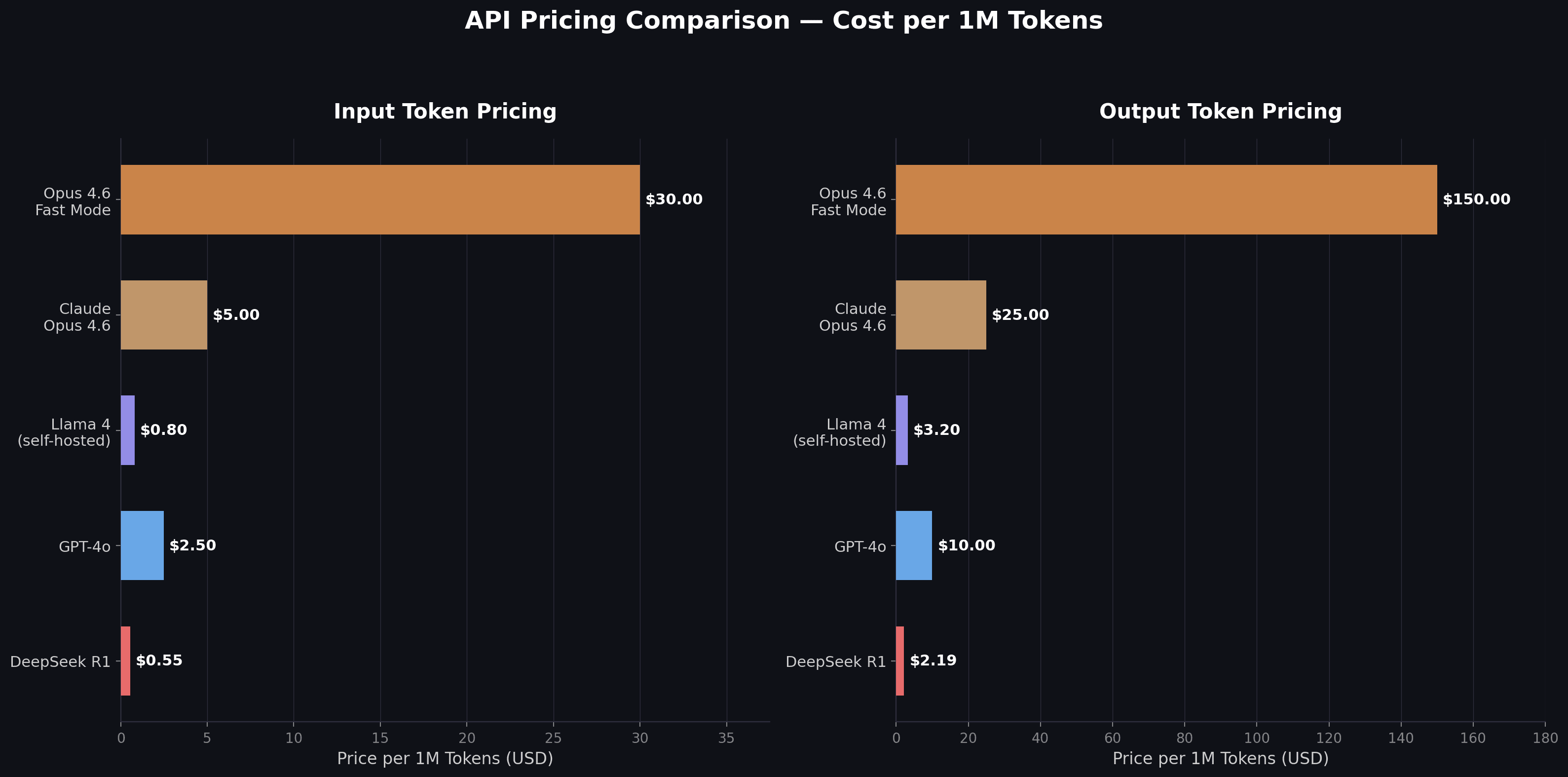
API Pricing
| Tier | Input (per 1M tokens) | Output (per 1M tokens) |
|---|---|---|
| Standard | $5.00 | $25.00 |
| Long Context (>200K input) | $10.00 | $37.50 |
| Fast Mode | $30.00 | $150.00 |
| US Data Residency | 1.1x standard | 1.1x standard |
Cost Optimization Options
- Prompt Caching (5-min TTL): Write at 1.25x input price; read at 0.1x input price
- Prompt Caching (1-hour TTL): Write at 2x input price; read at 0.1x input price
- Batch API: 50% discount on both input and output tokens
Consumer Plans
- Claude Pro: $20/month
- Claude Max: $200/month (removes most usage limits)
How It Compares on Price
Opus 4.6 is a premium model priced accordingly. At 25 per million tokens (input/output), it's roughly 2.4x more expensive than GPT-4o (10), and orders of magnitude more expensive than DeepSeek R1. Fast mode, at 150, is designed for latency-critical applications and priced aggressively.
The Batch API discount (50% off) makes Opus 4.6 more accessible for offline processing workloads like document analysis, code review pipelines, and data extraction.
Architecture: What Changed Under the Hood
Anthropic does not publish parameter counts or full architectural details. What we do know:
Adaptive Thinking Architecture
The most fundamental change. Instead of a fixed reasoning budget, the model dynamically allocates cognitive effort. Hidden reasoning traces are generated before visible text begins streaming. This explains the increased "time to first token" latency and the breaking change around assistant message prefilling (the model must output a thinking block as its very first token).
Re-Engineered Attention Mechanisms
To achieve reliable 1M-token context processing, Anthropic performed what they describe as "a structural expansion and a re-engineering of attention mechanisms." The previous "context rot" problem, where retrieval accuracy degraded as context approached capacity, has been substantially mitigated.
Distributed Agent State Model
Agent Teams use a fundamentally different approach to multi-agent coordination. Instead of sub-agents sharing a single context window (as in Opus 4.5), each agent operates with an independent context window of up to 1M tokens. This eliminates the serial bottleneck that limited the previous generation.
Where Opus 4.6 Excels: Real-World Use Cases
Based on benchmarks, early adopter reports, and Anthropic's own testing:
Agentic Coding
The primary use case. With the highest Terminal-Bench 2.0 score (65.4%), Agent Teams capability, and 1M-token context for ingesting entire codebases, Opus 4.6 is currently the most capable model for autonomous coding tasks. The Agent Teams demo of building a full C compiler across three architectures is a statement of intent.
Enterprise Knowledge Work
The GDPval-AA results (1,606 Elo, 70% win rate vs. GPT-5.2) combined with domain-specific benchmarks (90.2% BigLaw, 76.0% TaxEval, 60.7% Finance Agent) paint a consistent picture: Opus 4.6 is designed for high-stakes professional work. Financial research, legal analysis, tax compliance, and regulatory review are all strong suits.
Long-Context Processing
76% accuracy at 1M tokens on 8-needle retrieval is the best result any model has achieved. For workflows that require digesting entire codebases, multi-year financial filings, comprehensive legal discovery sets, or research literature reviews, Opus 4.6 has no serious competition.
Scientific Research
Anthropic reported approximately 2x improvement over Opus 4.5 on computational biology, structural biology, organic chemistry, and phylogenetics benchmarks. The 128K output token limit also enables comprehensive research reports in a single generation.
Cybersecurity
During testing, Opus 4.6 reportedly found over 500 previously unknown high-severity security flaws in open-source libraries. Anthropic has applied new safeguards around this capability and noted they may institute real-time intervention to block potential abuse.
The Caveats: Where Opus 4.6 Falls Short
No model is without trade-offs, and Opus 4.6 has several worth understanding before adoption.
Writing Quality Regression
The most vocal user criticism. Many report that Opus 4.6 produces "flatter, more generic prose" than Opus 4.5. Reddit posts titled "Opus 4.6 lobotomized" and "Opus 4.6 nerfed?" gained significant traction. In a blind test by the publication Every, the editorial team preferred Opus 4.5's prose quality. The emerging theory: heavy reinforcement learning optimizations for reasoning came at the cost of natural language generation quality. If writing is your primary use case, test carefully before migrating.
Token Consumption
Early adopters report Opus 4.6 consumes roughly 5x more tokens per task than Opus 4.5 due to adaptive thinking. The model "thinks harder by default," generating extensive hidden reasoning traces. While per-token pricing is unchanged, total cost per task can increase substantially. Users on the $200/month Max subscription reported reaching 27%+ of weekly usage limits within a single day.
Tool Use Regression
MCP Atlas dropped from 62.3% (Opus 4.5) to 59.5% (Opus 4.6). If your workflows depend heavily on precise structured tool calling, benchmark your specific use cases before upgrading.
1M Context Restrictions
The headline 1M context window is in beta and restricted to API users at tier 4 and above. It's not available to Claude Max subscribers. Premium pricing (37.50 per MTok) applies above 200K input tokens.
Higher Latency
The "max" adaptive thinking level provides the strongest capability but at noticeably higher latency. Time to first token is generally slower than Opus 4.5 across all effort levels due to the mandatory thinking pause.
Breaking API Change
Prefilling assistant messages (a common technique for steering output format) returns a 400 error on Opus 4.6. Developers must migrate to structured outputs or system prompt instructions.
The Competitive Landscape: A Summary Matrix
| Dimension | Claude Opus 4.6 | GPT-5.2 | Gemini 3 Pro | Llama 4 Maverick | DeepSeek R1 |
|---|---|---|---|---|---|
| Context Window | 1M (beta) | -- | 1M+ | 10M (Scout) | 128K |
| Max Output | 128K | -- | -- | -- | -- |
| Reasoning (ARC AGI 2) | 68.8% | 54.2% | 45.1% | -- | -- |
| Coding (Terminal-Bench) | 65.4% | 64.7% | 56.2% | -- | -- |
| Web Research (BrowseComp) | 84.0% | 77.9% | 59.2% | -- | -- |
| Long Context (MRCR v2) | 76% | -- | 26.3% | -- | -- |
| Enterprise (GDPval-AA) | 1,606 | ~1,462 | -- | -- | -- |
| Multilingual (MMMLU) | 91.1% | -- | 91.8% | -- | -- |
| Video Processing | No | Yes | Yes | Yes | No |
| Open Source | No | No | No | Yes | Yes |
| Self-Hostable | No | No | No | Yes | Yes |
| API Cost (Input/Output) | 25 | ~$2-5 | Varies | Free (infra cost) | ~$0.14-0.55 |
Who Should Use Opus 4.6?
Use Opus 4.6 if you need:
- The strongest available reasoning for complex, multi-step problems
- Agentic coding workflows that require autonomy over large codebases
- Processing massive documents (legal, financial, scientific) in a single context
- Enterprise knowledge work with high accuracy requirements
- Multi-agent orchestration for ambitious coding projects
Consider alternatives if you need:
- Cost-efficient processing at scale (DeepSeek R1, Llama 4)
- High-quality creative writing (Opus 4.5 may still be preferable)
- Video processing (Gemini 3 Pro, Llama 4)
- Self-hosted deployment with full control (Llama 4, DeepSeek)
- Multilingual tasks where every fraction of a point matters (Gemini 3 Pro)
Conclusion: The State of the Frontier
Claude Opus 4.6 is, by most measurable benchmarks, the most capable AI model available as of February 2026. It holds the #1 spot on the Artificial Analysis Intelligence Index, leads on novel reasoning (ARC AGI 2), enterprise knowledge work (GDPval-AA), agentic web research (BrowseComp), and long-context processing (MRCR v2). The Agent Teams feature, while still in research preview, represents a genuine architectural leap in how AI models can collaborate.
But "most capable" doesn't mean "best for everyone." The writing quality regression is real. The token consumption increase is significant. The premium pricing puts it out of reach for many use cases where open-source alternatives deliver 80-90% of the capability at a fraction of the cost.
The frontier model landscape in 2026 is not a winner-take-all market. It's a portfolio decision. Opus 4.6 for your hardest reasoning and agentic tasks. GPT-5.2 or Gemini 3 Pro for specific strengths in their respective ecosystems. Llama 4 or DeepSeek R1 for cost-sensitive, high-volume workloads. The organizations that thrive will be the ones that match models to tasks rather than picking a single provider and hoping for the best.
The real story of February 5, 2026 isn't that one model won. It's that the gap between the frontier models is narrowing while the gap between what AI can do and what most organizations are actually doing with it continues to widen. The bottleneck isn't intelligence anymore. It's implementation.
References
- Anthropic - Introducing Claude Opus 4.6
- TechCrunch - Anthropic releases Opus 4.6 with new 'agent teams'
- Artificial Analysis - Claude Opus 4.6 Intelligence, Performance & Price Analysis
- DataCamp - Claude Opus 4.6: Features, Benchmarks, Tests, and More
- Digital Applied - Claude Opus 4.6 Features, Benchmarks, and Pricing Guide
- Vellum - Claude Opus 4.6 vs 4.5 Benchmarks Explained
- The New Stack - Anthropic's Opus 4.6 is a step change for the enterprise
- Fortune - Anthropic's Claude triggered a trillion-dollar selloff
- TechRadar - Anthropic says Opus 4.6 found 500+ security flaws
- CosmicJS - Claude Opus 4.6 vs Opus 4.5: A Real-World Comparison
- Every - Vibe Check: Opus 4.6
- GitHub Blog - Claude Opus 4.6 is now available for GitHub Copilot
- Microsoft Azure Blog - Claude Opus 4.6 in Microsoft Foundry
- Google Cloud Blog - Expanding Vertex AI with Claude Opus 4.6
- Claude API Docs - What's new in Claude 4.6
- Claude API Docs - Pricing