
Why the First Token Matters More Than the 10,000th
Why the First Token Matters More Than the 10,000th
The Conversation That Drifted
You've been working with an AI agent for two hours. It started sharp — following your instructions precisely, catching edge cases, writing code in exactly the style you asked for. But somewhere around message forty, something shifted. The responses are still coherent. They're still grammatically correct. But the model seems to have... forgotten what you were trying to do. It starts suggesting approaches you explicitly ruled out in the first message. It drifts from the architecture you agreed on. It loses the thread.
You haven't hit the context limit. There's still room in the window. So what happened?
The answer lies in something fundamental about how language models process information — and it starts with a counterintuitive truth: the first token you send is astronomically more influential than the ten-thousandth.
How a Model Reads Your Prompt
To understand why position matters, we need to understand how transformers actually process a sequence of tokens.
A language model doesn't read your prompt the way you read a book — linearly, word by word, building understanding as it goes. Instead, it processes the entire sequence through multiple layers of self-attention, where every token gets to "look at" every other token that came before it.
At each layer, every token computes three vectors: a query ("what am I looking for?"), a key ("what do I contain?"), and a value ("what information should I pass along?"). The attention mechanism matches queries to keys to decide how much each token should attend to every other token. The result is a weighted sum of values — a new representation for each position that encodes not just what that token is, but what it means in context.
Here's the critical part: in autoregressive models (GPT, Claude, LLaMA, and essentially every modern chat model), attention is causal. Token 500 can attend to tokens 1 through 499, but token 1 can only attend to itself. This creates a fundamental asymmetry:
Every single token in the sequence looks at token 1. But token 1 looks at nothing but itself. This means token 1's representation is embedded, in some form, in the hidden states of every subsequent token. It's the one signal that propagates through the entire sequence. Token 10,000? Only the tokens that come after it ever see it.
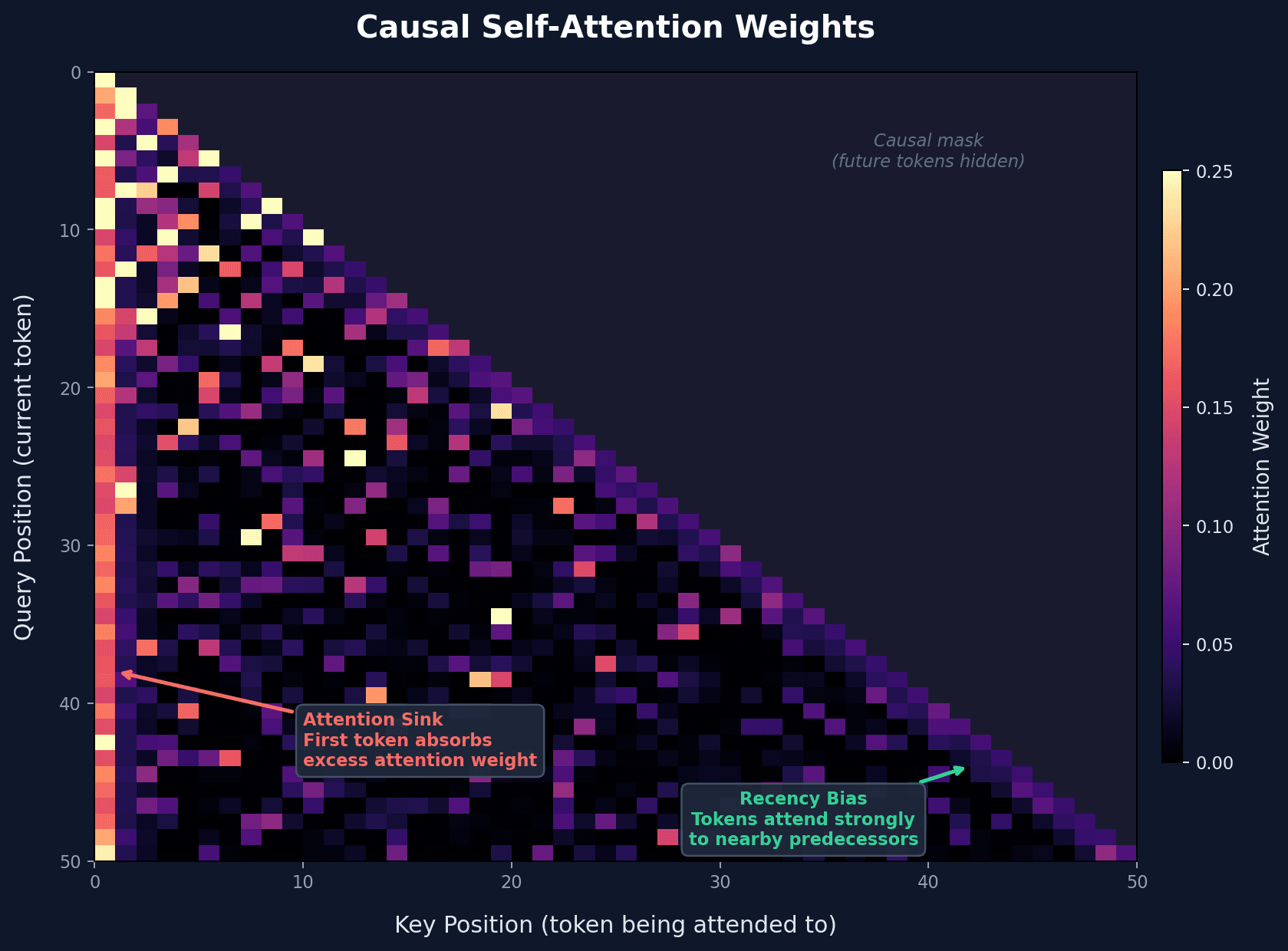
The heatmap above shows a simulated causal attention matrix. Notice two patterns: the bright vertical stripe on the left edge (every token attends heavily to the first few positions — the attention sink) and the bright diagonal (tokens attend to their recent neighbors). The dark triangle in the upper right is the causal mask — tokens can't see the future.
This is not a design flaw. It's the mathematical structure of autoregressive attention. And it has profound consequences.
The Attention Sink: Why Models Stare at the Beginning
In 2023, researchers Xiao, Tian, Gunter, Li, and Su from MIT and Meta AI published a paper that formally identified a phenomenon they called "attention sinks." The finding was striking: across multiple transformer architectures, the very first token in a sequence consistently receives a disproportionately high share of attention — regardless of what that token actually contains.
Even when the first token is a meaningless padding symbol, a BOS (beginning-of-sequence) marker, or a newline character, attention heads across the model devote significant weight to it. The researchers found that in some layers, more than 20% of all attention weight concentrates on the first few tokens — far more than any semantic relevance would justify.
Why? The softmax function in the attention mechanism requires attention weights to sum to 1.0. When a token doesn't have a strong reason to attend to any specific position, the excess attention flows to the first token — because it's always there, it's always been processed through the most layers, and its representation has been refined across the entire depth of the network. The model needs somewhere to "dump" attention, and position 1 becomes the default drain.
But a 2025 paper by Barbero et al., "Why do LLMs attend to the first token?", revealed something deeper. Attention sinks aren't just a quirk of softmax — they're a learned defense mechanism against representational collapse. At each transformer layer, the attention matrix mixes different tokens' representations together. Over many layers and long sequences, this mixing pushes all token representations toward the same vector — a catastrophic loss of information diversity. Attention sinks act as no-ops: by fixating on the BOS token, the model reduces token interaction at specific layers, preserving representation diversity across the network's depth.
Their empirical analysis on LLaMA 3.1 405B found that over 80% of attention heads exhibit strong sink behavior. And critically, larger models need stronger sinks — suggesting this isn't a bug to be trained away but a fundamental architectural necessity.
The attention sink isn't just a curiosity. It has practical implications:
| Observation | Implication |
|---|---|
| First tokens receive ~20%+ attention regardless of content | They disproportionately influence the model's internal representations |
| Removing the first token causes perplexity to spike dramatically | The model's prediction quality depends on early-position anchors |
| The effect persists across model sizes and architectures | This is a structural property of transformers, not a training artifact |
The StreamingLLM paper demonstrated this by showing that you could process infinitely long sequences with a small sliding window — as long as you kept the first few tokens (the attention sinks) intact. Specifically, keeping just the first 4 tokens plus the most recent 1,020 tokens in the KV cache fully restored perplexity compared to using the full context. A pure sliding window without those initial tokens? Catastrophic failure. The technique is now integrated into HuggingFace Transformers and NVIDIA TensorRT-LLM.
The message is clear: the first tokens aren't just "the beginning." They're the foundation the entire sequence stands on.
The Trajectory Problem: First Tokens Set the Direction
There's a second, more intuitive reason the first tokens matter so much, and it has to do with how autoregressive generation actually works.
When a model generates text, it produces one token at a time. Each new token is conditioned on everything that came before it. But here's the thing: the probability distribution for token 2 depends entirely on token 1. The distribution for token 3 depends on tokens 1 and 2. And so on. The generation process is a chain of conditional probabilities, where each step narrows the space of likely continuations.
Think of it like a river delta. At the source, the river could flow in many directions. Each bend narrows the possibilities. By the time you're a thousand kilometers downstream, you're locked into a specific channel — and the bends that mattered most were the ones at the beginning.
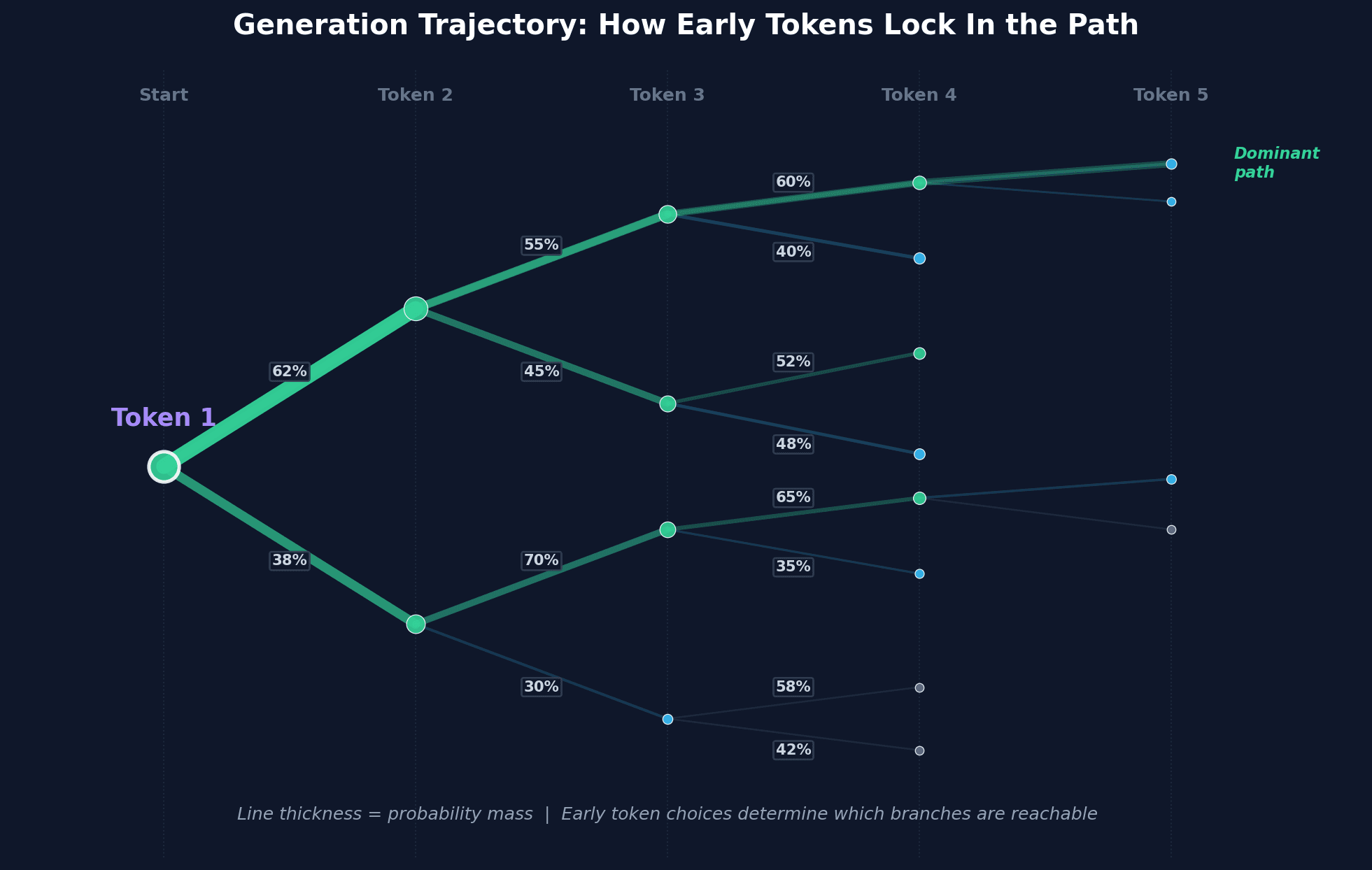
This is why the system prompt matters so much. It's not just "instructions" — it's the initial bend in the river. It establishes the probability landscape that everything else flows through. A system prompt that says "You are a Python expert who writes concise, well-tested code" doesn't just tell the model what to do. It shifts the probability distributions for every subsequent token toward Python-flavored, concise, test-aware completions. By the time the model is processing token 5,000, that initial bias has compounded through thousands of conditional steps.
And here's where it gets uncomfortable: a single misleading or poorly worded token at position 1 can have more impact on the final output than a carefully crafted paragraph at position 10,000.
The Graph-Theoretic View
A 2025 paper by Wu et al., "On the Emergence of Position Bias in Transformers," formalized this intuition by modeling the transformer as a message-passing graph. With causal masking, early tokens can broadcast their signal through many layers and positions, while late tokens have only a few short hops to the readout — so their signal gets "over-squashed."
Making it worse: starting from the second layer, tokens don't attend to raw inputs. They attend to contextualized representations that are already influenced by earlier tokens. This creates a compounding effect — early tokens influence later ones both directly (through attention) and indirectly (through intermediate token representations that have already been shaped by them). The causal mask topology structurally privileges the head of the prompt.
Two competing forces ultimately shape the attention distribution:
- The causal mask steers focus toward earlier tokens (primacy)
- Positional encodings and recency emphasize nearby tokens
- Residual connections prevent complete collapse onto the first token
The interplay of these three forces produces the characteristic U-shaped position bias — strong attention to beginning and end, weak in the middle.
Lost in the Middle: The U-Shaped Curve
The importance of position isn't just theoretical. In 2023, researchers Liu, Lin, Hewitt, Paranjape, Bevilacqua, Petroni, and Liang from Stanford published "Lost in the Middle: How Language Models Use Long Contexts" — a paper that has since become one of the most cited references in the field.
Their experiment was elegantly simple: give a model a question and place the answer at different positions within a long context. Then measure how well the model finds and uses that answer.
The result was a clear U-shaped performance curve:
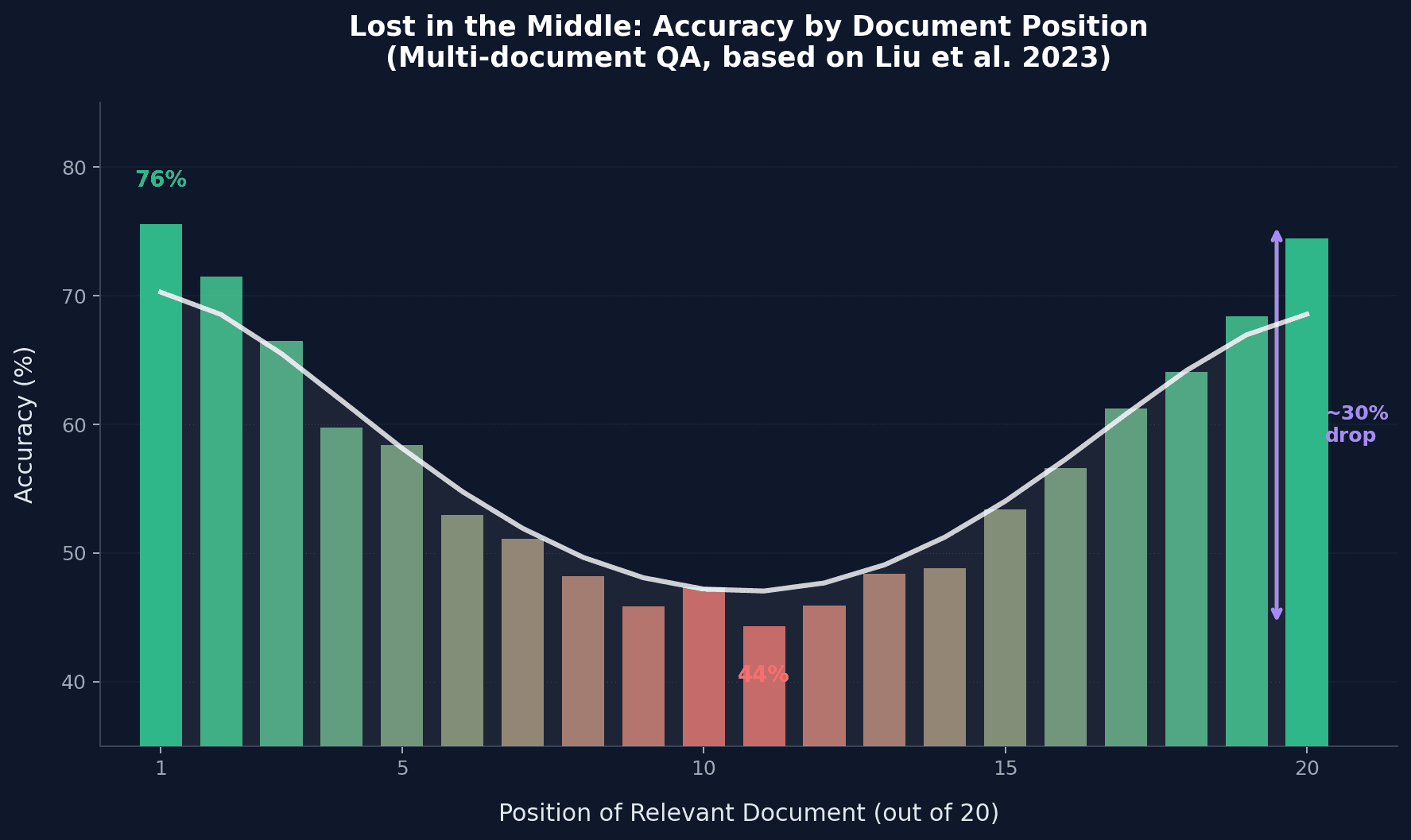
Models were excellent at using information at the beginning (primacy effect) and the end (recency effect). But information in the middle — even if it was the only correct answer — was frequently ignored. Performance dropped by more than 30% for middle-positioned content.
Two mechanisms drive this:
-
Causal attention bias. As we discussed, earlier tokens accumulate disproportionately high attention scores. They've been refined through more layers of self-attention, and every subsequent token has had the opportunity to attend to them.
-
Positional encoding decay. Modern models use Rotary Positional Embeddings (RoPE), which encode relative distance between tokens. As the distance between two tokens grows, the attention score between them decays. Tokens close to the beginning maintain strong connections with many tokens. Tokens buried deep in the middle are far from both the beginning and the end, trapped in an attention dead zone.
The practical consequence is devastating for the naive assumption that "more context = better results." You can have a million-token window, but if the critical information is at position 500,000, the model might literally not notice it.
Bigger Windows, Same Physics
The industry loves to announce bigger context windows. 128K. 1M. 10M. And there's no question that larger windows enable genuinely new capabilities — processing entire codebases, analyzing lengthy legal documents, maintaining long conversations.
But bigger windows don't change the fundamental physics of attention.
In July 2025, Chroma Research published a devastating empirical study called "Context Rot." They tested 18 frontier models — including GPT-4.1, Claude Opus 4, and Gemini 2.5 — and found that every single model exhibited performance degradation as input length increased. Not some models. Not older models. Every model they tested.
The decline wasn't a cliff — it was continuous and compounding. A model with a 200K-token window could show significant degradation at just 50K tokens. Three mechanisms compound: the lost-in-the-middle effect, attention dilution from quadratic scaling, and distractor interference from semantically similar irrelevant content.
A model with a 1-million-token window still has attention sinks at the beginning. It still exhibits the U-shaped curve. It still weights early tokens more heavily than middle tokens. The window got bigger, but the distribution of influence within it didn't become uniform.
Think of it this way:
| Context Size | Tokens with strong influence (beginning + end) | Tokens in the "dead zone" (middle) |
|---|---|---|
| 4K tokens | ~1,500 | ~2,500 |
| 128K tokens | ~20,000 | ~108,000 |
| 1M tokens | ~100,000 | ~900,000 |
As the window grows, the dead zone grows faster. You get more room, but most of that room is in the middle — the part the model pays least attention to.
This doesn't mean large context windows are useless. Far from it. They enable tasks that were previously impossible — like analyzing a full repository in a single pass. But they come with a hidden tax: the more you put in the window, the more the early tokens have to compete with. And the evidence shows that early tokens almost always win.
Why Short Sessions Beat Long Ones
This brings us to a practical recommendation that surprises many people: short-lived sessions often outperform long ones.
Here's the intuition. In a fresh session, your system prompt sits at position 1. Your instructions are the first thing the model processes. They receive maximum attention weight, maximum positional advantage, and they set the initial trajectory for everything that follows.
Now imagine you're 200 messages into a conversation. Your original system prompt is still at position 1, but it's now followed by hundreds of thousands of accumulated tokens — questions, answers, code blocks, corrections, tangents. The model still processes the system prompt, but its influence has to compete with an enormous volume of subsequent context.
The math is straightforward. If your system prompt is 1,000 tokens and the total context is 2,000 tokens, those instructions represent 50% of the attention landscape. Grow the context to 80,000 tokens? Those same 1,000 tokens now represent roughly 1.25%. The instructions didn't change. Their relative weight did.
The degradation isn't always obvious. It's not like the model suddenly ignores your instructions. It's more subtle:
- Instruction drift. The model's behavior slowly shifts away from the initial prompt toward patterns that emerge in the accumulated conversation.
- Diluted attention. With more tokens in the window, each individual token's share of the attention budget shrinks. The system prompt that commanded the model's focus at message 1 now fights for attention against 100,000 other tokens.
- Accumulated noise. Every exchange adds tokens. Some are highly relevant. Many are noise — polite transitions, repeated context, failed approaches. This noise accumulates and gradually drowns out the signal from the initial instructions.
This is why experienced AI practitioners often restart sessions for important tasks. Not because the model is "broken" — but because a fresh start gives the initial instructions their maximum influence.
Context Compression: A Reset Button, Not a Shortcut
If long sessions are a problem, you might wonder: what about context compression? Systems like Claude Code use compression to manage long conversations — condensing earlier messages into a summary when the context gets too large.
But here's the key insight that most people miss: context compression isn't primarily a memory management technique. It's a mechanism for preserving the influence of first tokens.
When a system compresses context, it restructures 70K tokens of accumulated conversation into roughly 8K tokens of high-signal content:
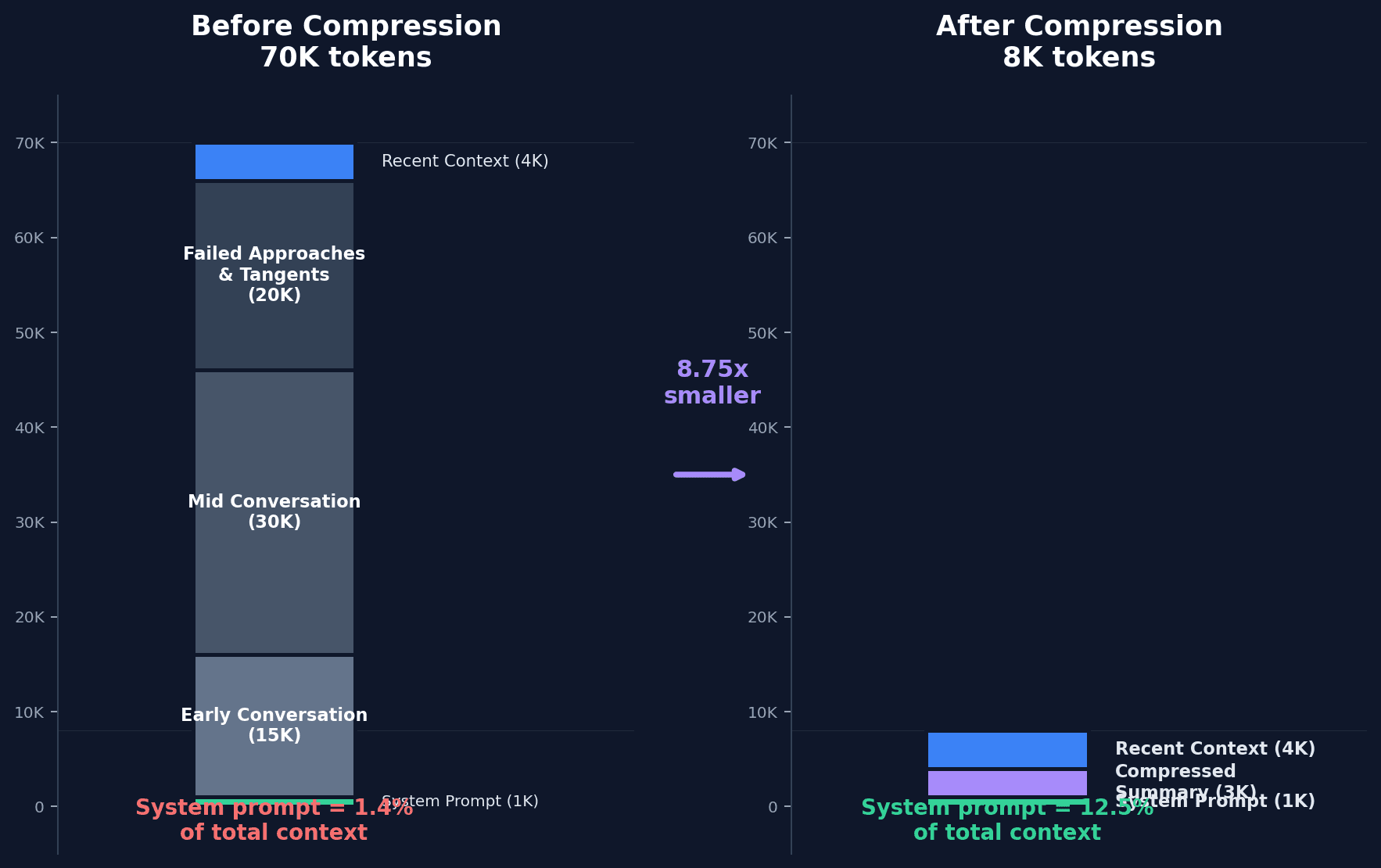
Notice the structure: initial context preserved verbatim at the front, noise replaced by a compressed summary in the middle, recent work kept intact at the end. This isn't accidental. It mirrors the U-shaped attention curve perfectly — putting the most important information where the model is most likely to use it (beginning and end), and condensing the historical noise into a brief middle section.
Compression effectively gives the model a "fresh start" while preserving:
- The original instructions — kept at the beginning, maintaining their positional advantage.
- The current state — summarized concisely, providing essential context without the noise.
- Recent context — at the end, where recency bias gives it strong attention.
In other words, compression is the system's way of fighting the natural decay of first-token influence. It removes the accumulated noise that was diluting the system prompt, and it rebuilds the context in a structure that maximizes attention where it matters most.
The results speak for themselves. Factory.ai evaluated their anchored iterative summarization approach across 36,000 real engineering session messages and found that compressed contexts consistently outperformed full uncompressed contexts in accuracy, completeness, and continuity. Microsoft's LLMLingua achieves up to 20x prompt compression with minimal performance loss — and notably, compression also mitigates the lost-in-the-middle effect by removing the noise tokens that create the dead zone.
This reframes what compression actually is. It's not a lossy fallback for when you run out of room. It's a deliberate architectural choice that restores the attention distribution to its most effective shape. Nearly 65% of enterprise AI failures in 2025 were attributed to context drift or memory loss during multi-step reasoning — not raw context exhaustion. The problem was never the size of the window. It was the noise inside it.
The Hidden Architecture of Influence
Let's zoom out and look at what we've established:
- Attention sinks ensure the first tokens receive disproportionate attention weight, regardless of their content.
- Causal masking means early tokens propagate through every subsequent hidden state, while late tokens influence only what comes after them.
- Trajectory setting means early tokens define the probability landscape that all generation flows through.
- The U-shaped curve means middle tokens are systematically underweighted in long contexts.
- Compression preserves the influence of initial tokens by resetting the context structure.
Put together, these mechanisms create what we might call an attention hierarchy:
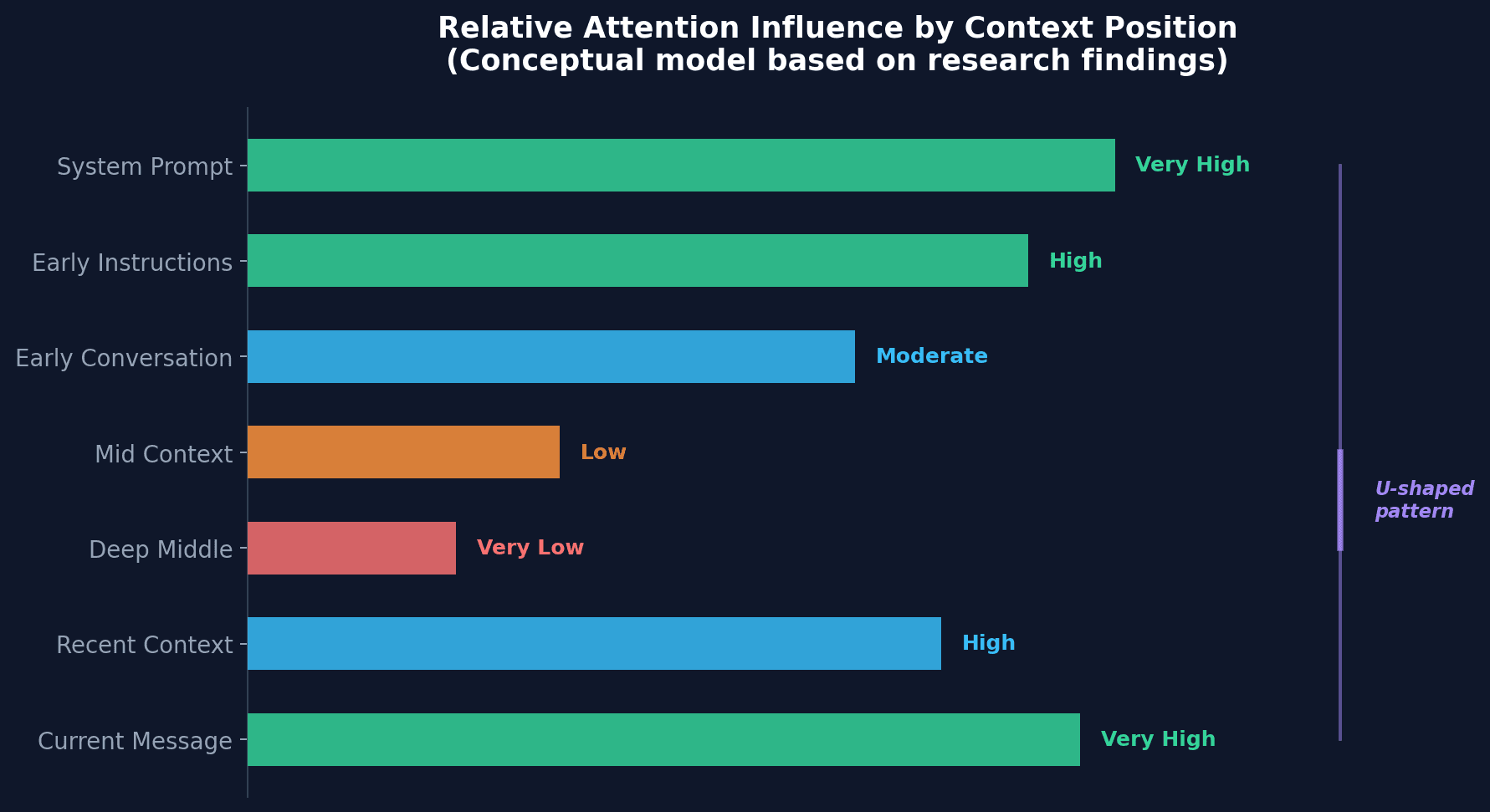
The shape is not uniform. It's not even roughly linear. It's a bathtub — high at the start, low in the middle, rising again at the end. And the beginning consistently dominates.
Practical Implications: Working With the Grain
Understanding token importance isn't just academic. It changes how you should interact with AI systems, and how you should design systems that use them.
For AI Users
- Craft your system prompt carefully. It's the most influential text in the entire conversation. A vague or generic prompt wastes the most powerful positional advantage you have.
- Front-load critical information. Don't bury key requirements at the end of a long prompt. Put them first.
- Start fresh for important tasks. A new session with a well-crafted prompt will outperform continuing a stale, drifted conversation.
- Be concise early, detailed late. The first few messages set the trajectory. Make them count. Save verbose explanations for later, where they're needed for specific context.
For AI Developers
- Design for short sessions. Build systems that encourage session restarts rather than infinitely long conversations.
- Implement compression strategically. When compressing context, always preserve the original system prompt and place it at the beginning. Summarize the middle. Keep recent context at the end.
- Use the U-curve to your advantage. In RAG systems, place the most relevant retrieved documents at the beginning of the context, not the middle.
- Monitor instruction drift. Build observability into your systems to detect when model behavior starts deviating from the initial prompt. That's your signal to compress or restart.
For Agent Designers
- Prefer many short agent runs over one long one. An agent that resets every 10-20 interactions with a fresh prompt and updated state summary will outperform one that runs for hundreds of messages with accumulated context.
- Treat compression as a feature, not a fallback. Don't wait for the context to overflow before compressing. Proactive compression at regular intervals keeps the model anchored to its instructions.
- Keep the initial context tight. Every unnecessary token in the system prompt dilutes the important ones. An effective system prompt is a concentrated signal, not a wall of text.
Why This Matters Now
We're in an era of expanding context windows and increasingly ambitious AI applications. Teams are building agents that run for hours, processing thousands of messages and making hundreds of tool calls. The assumption is often that more context is always better — that if you give the model everything, it will use everything.
The research tells a different story. More context gives the model more information, yes. But it doesn't change the fundamental attention dynamics that prioritize the beginning and end of the sequence. It doesn't prevent instruction drift. It doesn't stop the middle from becoming a dead zone.
The most effective AI systems aren't the ones with the biggest context windows. They're the ones that understand how influence flows through a sequence and design around it. They keep first tokens sharp, compress context strategically, and aren't afraid to start fresh.
Because in a language model, the first token isn't just the first thing the model reads. It's the thing the model reads most carefully — every single time.
References
- Efficient Streaming Language Models with Attention Sinks -- Xiao et al., 2023 (arXiv)
- Why do LLMs attend to the first token? -- Barbero et al., 2025 (arXiv)
- On the Emergence of Position Bias in Transformers -- Wu et al., 2025 (arXiv)
- Lost in the Middle: How Language Models Use Long Contexts -- Liu et al., 2023 (arXiv)
- Attention Is All You Need -- Vaswani et al., 2017 (arXiv)
- RoFormer: Enhanced Transformer with Rotary Position Embedding -- Su et al., 2021 (arXiv)
- Context Rot: How Increasing Input Tokens Impacts LLM Performance -- Chroma Research, 2025
- Compressing Context -- Factory.ai, 2025
- LLMLingua: Innovating LLM Efficiency with Prompt Compression -- Microsoft Research, 2023
- Effective Context Engineering for AI Agents -- Anthropic, 2025
- Transformers Are Born Biased -- 2026 (arXiv)
- Understanding Context Windows: Finally -- Gino Marín
- What Are Attention Sinks in LLMs? -- Hugging Face Blog
- A Survey on Long Context Scaling in Large Language Models -- arXiv, 2024